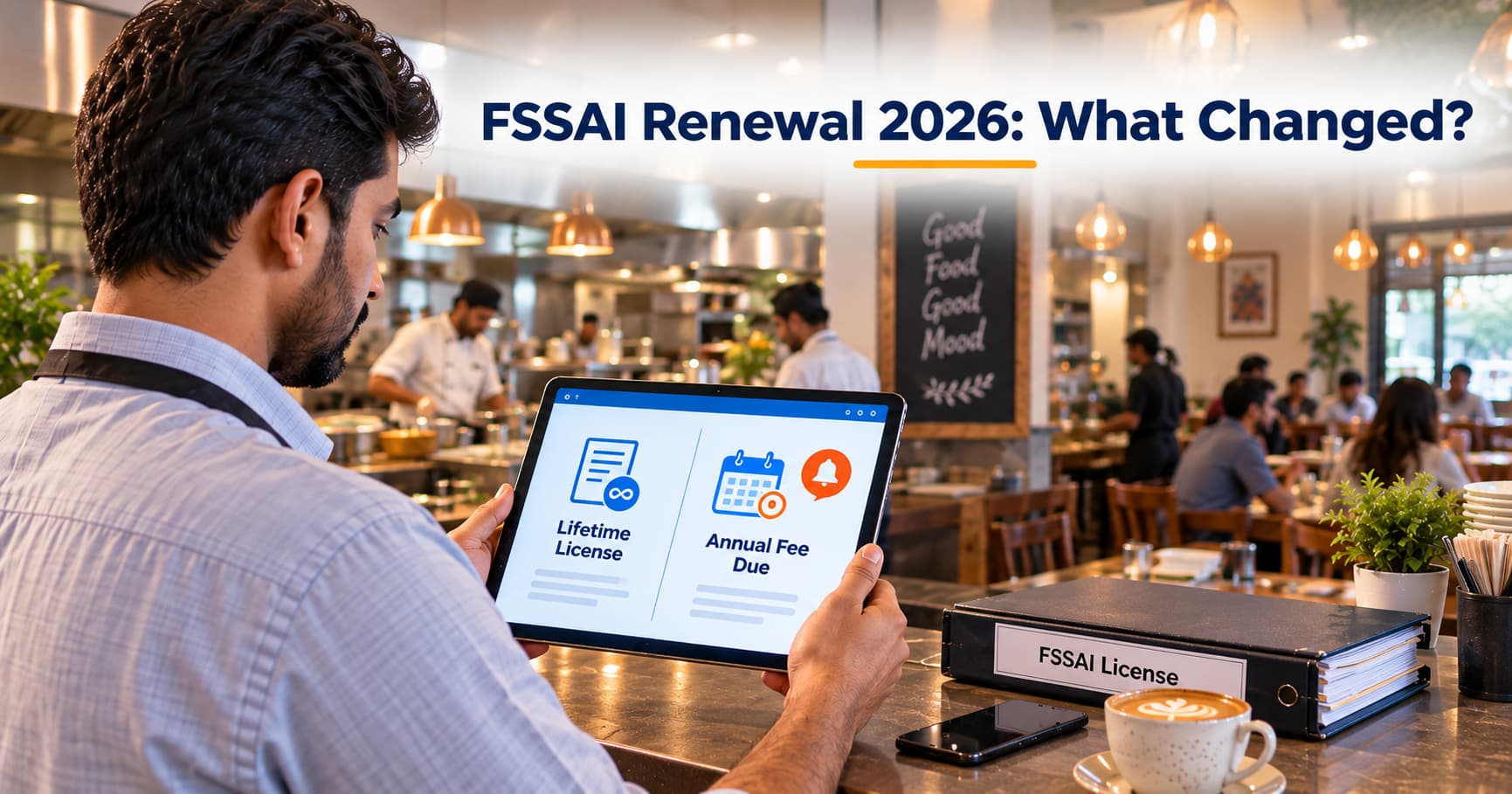
From April 2026, new FSSAI (Food Safety and Standards Authority of India) licenses no longer expire on a fixed 1–5-year cycle they're valid for a lifetime (perpetual validity). But this does not mean restaurant owners can forget about FSSAI entirely. The annual fee still has to be paid every year, and missing that payment triggers automatic license suspension with no renewal reminder from FSSAI itself. Understanding this difference is now more important than ever for restaurant, cafe, and cloud kitchen owners.
What is FSSAI?
FSSAI stands for the Food Safety and Standards Authority of India — the government body responsible for regulating and supervising food safety across the country. Under the Food Safety and Standards Act, 2006, every restaurant, cafe, cloud kitchen, catering business, or any establishment that prepares or sells food is legally classified as a Food Business Operator (FBO) and must hold a valid FSSAI license or registration to operate. Operating without one is a criminal offence, not just a compliance lapse which is exactly why staying on top of FSSAI requirements matters as much as any other core business function.
Who This Affects
If you run any of the following, this change applies to you directly:
- A dine-in restaurant, casual eatery, or fine-dining establishment
- A cafe, bakery, or sweet shop
- A cloud kitchen or delivery-only kitchen
- A catering business or banquet hall with food service
- A multi-outlet restaurant chain (each outlet needs its own license, and its own fee tracking)
FSSAI licensing is premises-specific so if you operate three branches, you have three separate annual fee deadlines to track, not one. Multi-outlet owners are, in practice, three times more exposed to this risk than a single-location restaurant.
Why This Confuses So Many Restaurant Owners
For years, FSSAI licenses worked on a simple, familiar cycle: apply, get approved for 1–5 years, renew before expiry, repeat. Restaurant owners built habits and calendar reminders around that cycle. Everyone understood "renewal date" as the one thing to track.
In March 2026, FSSAI changed this system. Licenses issued after April 1, 2026 are now perpetual they don't expire on a fixed date. On the surface, this sounds like good news: one less renewal application to file, one less document to resubmit every few years.
But the change created a new, less visible risk. The license doesn't expire but it can still be suspended if the annual fee isn't paid, and unlike the old renewal cycle, there's no FSSAI-issued reminder telling you the fee is due. Owners who assume "perpetual means nothing to do" are exactly the ones most likely to get caught out often discovering the suspension only when an inspector or an aggregator platform flags it.
Why is this risky?
Because the old system had one big, memorable deadline every few years. The new system has a small, easy-to-forget deadline every single year, with zero built-in reminders and zero grace period.
Old Rule vs New Rule: What Actually Changed
| Aspect | Old System (Before April 2026) | New System (From April 2026) |
|---|---|---|
| License validity | Fixed term: 1 to 5 years | Perpetual (lifetime, no fixed expiry) |
| Renewal requirement | Mandatory renewal application before expiry | No renewal application needed |
| Annual fee | Bundled into the multi-year renewal fee | Must be paid separately, every single year |
| What happens if you miss a deadline | Late fee (₹100/day) until renewed | Automatic suspension — no grace period, no reminder |
| Risk of losing track | Low renewal date was a known, single event | Higher annual fee is easy to forget precisely because "renewal" no longer feels urgent |
| Turnover-based license category | Based on older threshold bands | Redrawn: Basic Registration up to ₹1.5 crore, State License ₹1.5 crore–₹50 crore, Central License above ₹50 crore |
| Multi-outlet tracking | One renewal date per outlet, spaced across years | One annual fee date per outlet, often falling in the same period |
The practical takeaway: the paperwork got simpler, but the consequence of forgetting got worse. A missed renewal used to mean a late fee. A missed annual fee now means your license and your legal right to operate gets suspended without warning.
What Actually Happens If Your License Gets Suspended
This isn't a minor administrative issue. A suspended FSSAI license means:
- You are legally not permitted to prepare or sell food until it's reinstated
- Food delivery aggregators (Zomato, Swiggy, and similar platforms) can pull your listing the moment their compliance check flags a suspended license
- Any inspection during the suspension period can result in penalties, in addition to the suspension itself
- Reinstating a suspended license takes time your restaurant spends unable to legally operate
How serious is a suspension? It's operationally equivalent to being shut down you cannot legally serve food, and third-party platforms will typically deactivate your listing until the license is active again.
How to Make Sure You Never Miss the Annual Fee Deadline
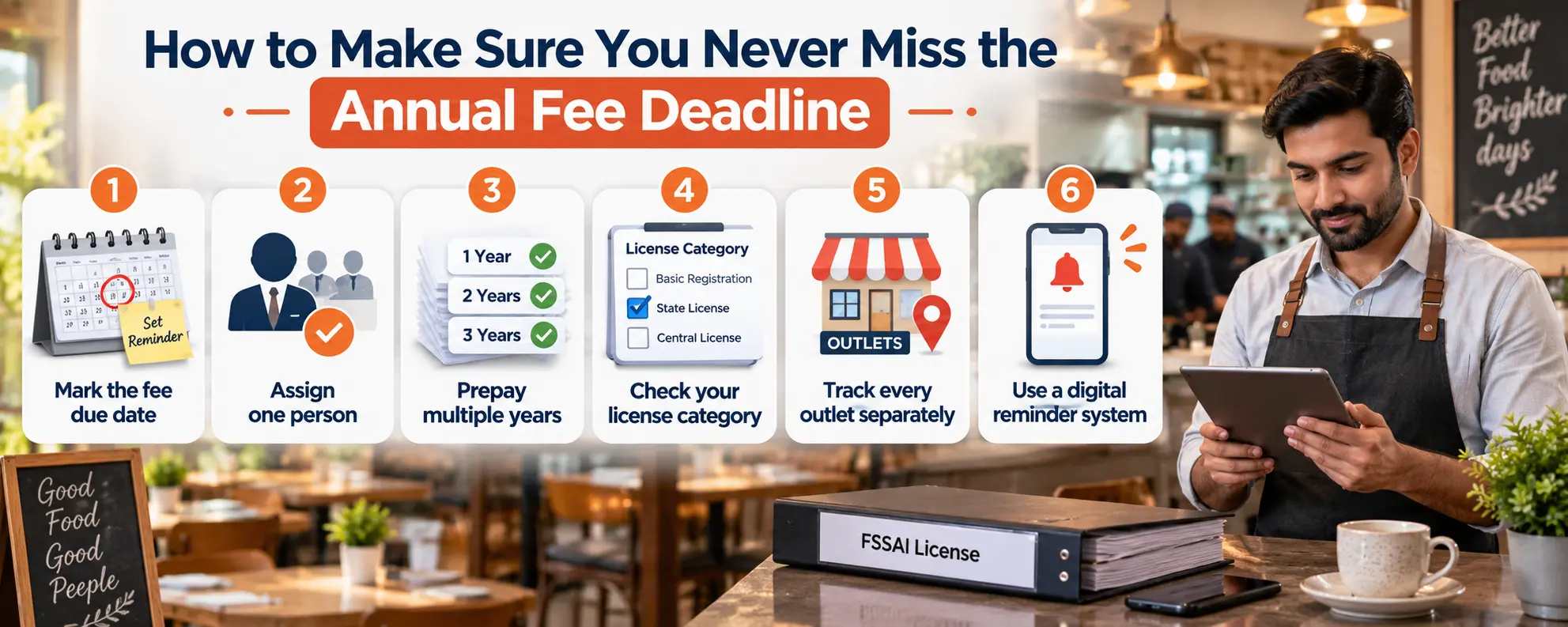
- Mark the fee due date on a fixed, recurring calendar entry don't rely on memory or on FSSAI to notify you, since no reminder process exists on their end.
- Assign the payment to one specific person in your team (owner, accountant, or manager) shared responsibility often means no one actually does it.
- Consider prepaying multiple years at once FSSAI allows advance payment of the annual fee for any number of years, which removes the yearly risk entirely.
- Check which license category you fall under after the 2026 turnover threshold changes if your turnover has grown, you may now need a State License instead of Basic Registration, which changes your compliance obligations.
- Track every outlet separately if you run a multi-branch business one missed fee at one branch is still a full suspension at that branch.
- Keep a digital, automated reminder system rather than a manual one a missed WhatsApp reminder is far less costly than a missed payment that suspends your license mid-service.
Quick Self-Check: Are You at Risk?
| Question | If Yes |
|---|---|
| Was your FSSAI license issued or renewed after April 1, 2026? | You're on the new perpetual system — track the annual fee, not a renewal date |
| Do you run more than one outlet? | You have multiple independent fee deadlines to track |
| Does one person "generally handle" compliance without a fixed reminder system? | You're relying on memory — the highest-risk pattern |
| Have you checked your current turnover-based license category since April 2026? | Your category may have changed and your obligations with it |
If you answered "yes" to two or more of these, it's worth setting up a proper tracking system now rather than after a suspension notice.
How RestoSoft Helps You Stay Ahead of This
This is exactly the kind of deadline that's easy to lose track of in the middle of daily restaurant operations staff schedules, orders, and supplier calls all compete for attention, and a once-a-year fee payment has no natural place in that routine.
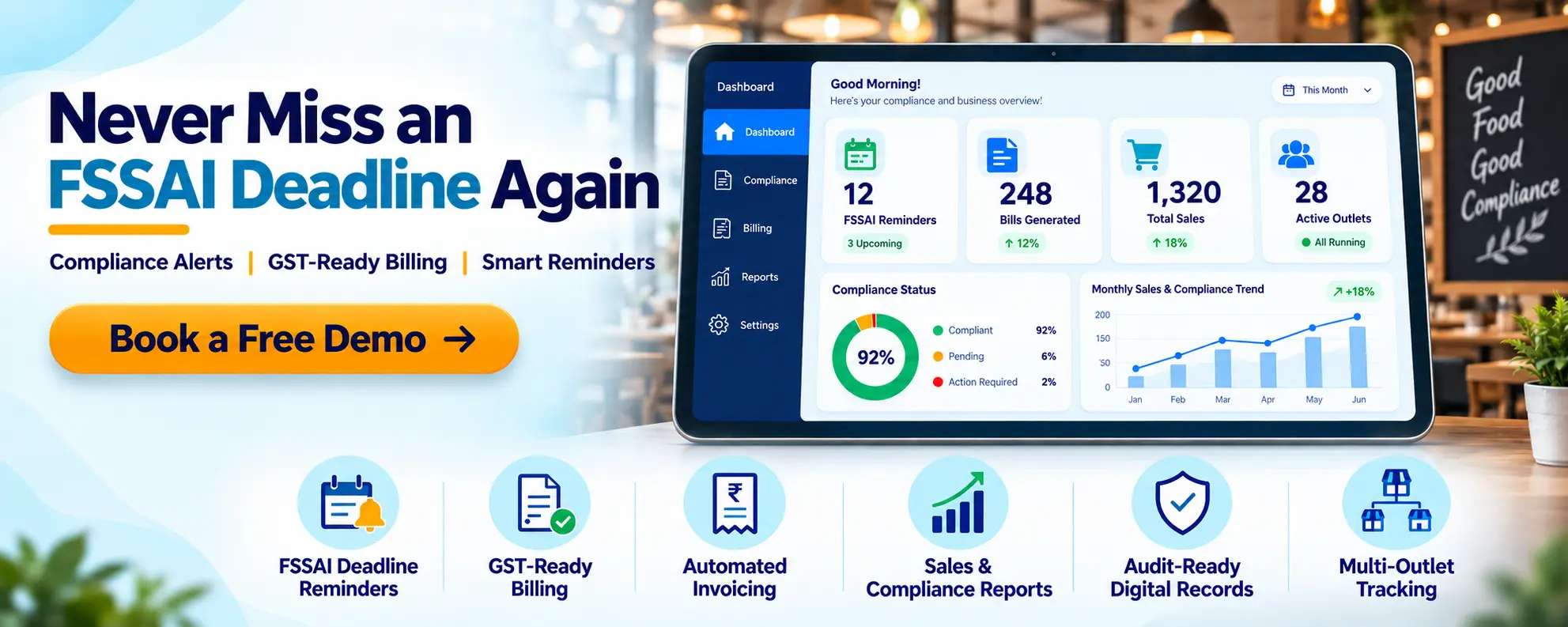
RestoSoft includes a built-in compliance and deadline reminder feature that alerts you ahead of key dates like your FSSAI annual fee for every outlet you run, individually. Instead of relying on memory, a sticky note, or FSSAI's non-existent renewal notice, you get an advance alert with enough time to act, well before any risk of suspension. See how RestoSoft compliance reminders work book a free demo.